
From parachute to wedding dress
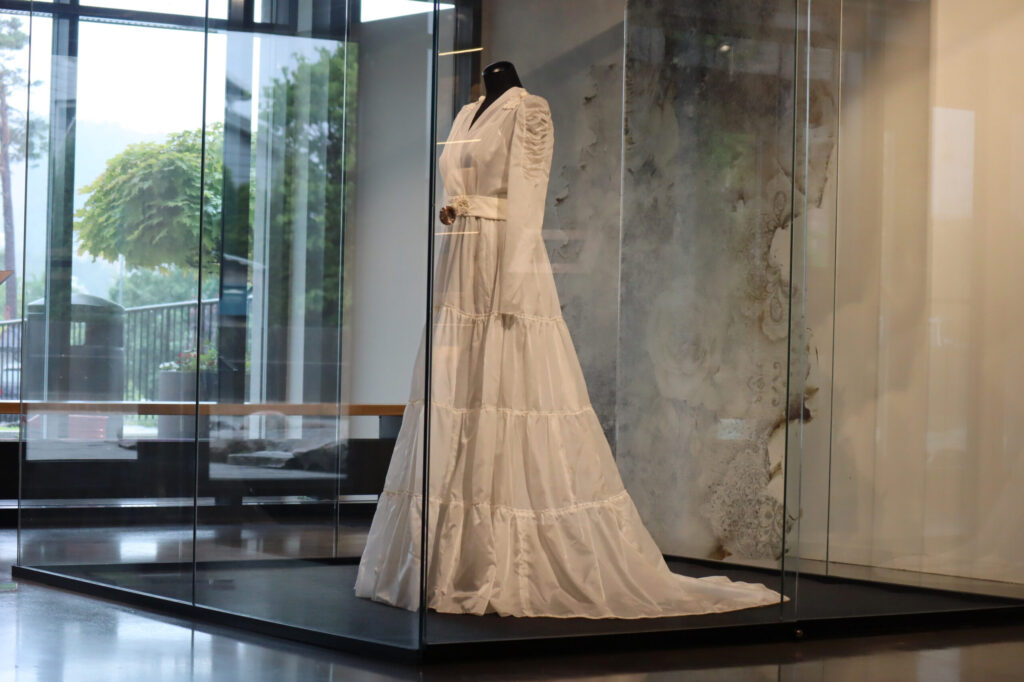
When Olga and Oddvar married in March 1946, Olga and her mother, Agnes Rødland, skillfully sewed the wedding dress themselves using a parachute that Oddvar had brought back from the mountains of Fyresdal.
Agnes Rødland: The Craftswoman Behind the Dress
The bride’s mother had trained as a dressmaker in her youth. Agnes Rødland (née Jakobsen) was born in 1901 and lived until 1989. During the early 1920s, she emigrated to the United States in search of work. She found employment as a housemaid in Brooklyn, where she met Elias Rødland, whom she later married.
The couple returned to Kvinesdal, where both had family roots, so that their first child, Olga, could be born there. They subsequently moved back to Brooklyn, where more children were born. In 1932, the family returned permanently to Norway and settled once again in Kvinesdal.
Although Agnes never pursued a professional career as a dressmaker, her skills were evident in the garments she created for her family. This wedding dress stands as a beautiful example of her craftsmanship and her ability to transform an ordinary parachute into an elegant bridal gown.
Olga appears to have inherited her mother’s talent with needle and thread and may well have learned sewing from her. She played a major role in making her own wedding dress. Olga and Oddvar’s children remember a childhood filled with the sound of sewing, as their mother regularly made clothes both for the family and for sale.
About the Dress
The dress is made from a white parachute, using the fabric commonly known as parachute silk. The parachute most likely dates from the mid-1940s, although the “silk” is in fact probably nylon. The material is smooth, lightweight, and slightly transparent, with a delicate sheen. To provide additional coverage, an underslip made from the same fabric is attached to the dress at the shoulders.
The matching belt is also made from the parachute fabric and fastens at the side with three press studs.
The dress is a classic example of 1940s fashion, featuring a wrap-front bodice, a V-shaped neckline, and strongly defined shoulders. Decorative appliqués made from parachute cords accentuate both the shoulders and the waist. The shoulder embellishments evoke the epaulettes found on military uniforms. As the groom wore a military uniform (albeit without epaulettes), it is possible that these design elements were chosen—whether consciously or subconsciously—to create a visual harmony between bride and groom.